

My Projects
Over this last summer, I completed 3 personal projects which I take great pride in. All 3 projects required a great deal of research, design and construction, and I have learned a lot through creation of these builds.

01
Potato Cannon
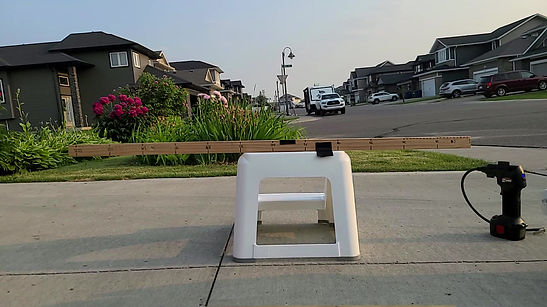
Over the start of summer, I decided to put my skills to the test with my first successful project, the High Pressure Air PVC Potato Launcher.
Through this project, I learned a lot about the basics of plumbing, solvent welding, pressure ratings and creating airtight seals. I also gained experience in working with PVC pipes and its various fittings like couplers, reducers, elbows, tees, bushings and nipples.
To ensure a faster pressure release and to provide a manually operably trigger, I modified a Rain Bird sprinkler solenoid valve, making it pneumatically actuated instead via a blowgun nozzle.
To ensure safety, pipes and fittings were solvent welded using glue specific to PVC, alongside strict adherence to printed instructions. Holes for the air valve and pressure gauge were drilled only at couplings where the material is twice as thick, and never on bare pipe. Teflon sealant tape was used appropriately for threaded connections. All parts of the cannon were built with Schedule 40 pressure rated pipe with a minimum pressure rating of 280 PSI.
large factors of safety were used, on top of the built in factors of safety that come with the official pressure rating. The device was never to be pressurized above 110 psi, thus maintaining a minimum safety factor of 2.5 against printed pressure ratings on any component capable of catastrophic rupture. Overall the estimated safety of factor against rupture is about 10. In addition, the cannon was not to be operated when temperatures exceeded 35 degrees C, as high temperatures reduce the strength of the material. Finally, the pipe was pressure tested at 150 PSI for 10 minutes to ensure safety and the absence of air leaks.
Above slow-motion capture of projectile motion at 960 fps yielded a calculated kinetic energy of 400 Joules. Very much a success, especially having gone from zero knowledge of PVC to the successful completion of this project
02
Motorized Bicycle
After the success of the potato cannon, I began my next project which was the motorized bicycle. After researching and watching countless videos about the subject, I purchased a 2 stroke gas engine kit and set off to work strapping it on to a suitable bicycle I found for cheap off Kijiji.


03
Bed Frame
This is my final project over summer of 2023. During the weeks leading to September, I knew I lacked a bed in my Edmonton residence, and at the same time realized I really wanted to make something with wood. Thus, the Wooden Bed Frame project was born.
The project, like most, began with the design. I needed it to be able to be 100% disassembled and reassembled with no damage to parts, so wood glue and screws were both out of the picture. Although expensive, I personally liked the mechanical aesthetic of the nut and bolt, so in the end, I designed the frame so that all joints were to be predrilled and fastened using 5/16 inch SAE nuts and bolts. Overall, the assembly uses 105 bolts, 105 nuts and 212 washers!
Sourcing good material for cheap proved to be difficult, but not impossible. The bed was to be built out of 2x4 and 2x8 dimensional lumber, which meant literally crawling through the piles of warped and bent wood at Home Depot to find that one perfect member. As they say: Cheap Good Fast, Pick 2.
Although it was tedious and time consuming, the overall installation process was quite straightforward except for the carburetor to cylinder head which had leaked fuel. This was a safety hazard I immediately set out to fix, which turned out to be the result of an inadequately strong ring clamp. Reinforcing the ring clamp solved this problem and sealed the connection permanently.
Being a bike bought off Kijiji, there were some immediate problems with the brakes which were fixed with a simple tune-up. In addition, a newer back wheel was installed for stability reasons under engine power. Finally, Threadlock was applied to all nuts and critical bolted joints were assessed on a weekly basis alongside other maintenance to ensure continued safety in the operation of this makeshift vehicle.
In the end, this motorized bicycle reached a maximum speed of 51 km/h, which is still very successful. In the end, I sold this bike for $800 to a mechanic who also had a passion for these projects, earning back double its cost.
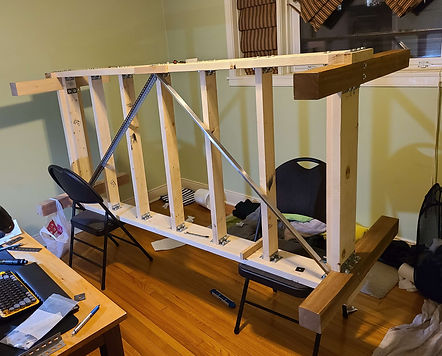
The actual construction of this bed involved basic wood working tools, like the drill, miter saw and power sander, requiring countless hours of tedious and precise cutting. This was a case where one mistake could cost half the project.
Finally, came drilling the holes. The holes had to be drilled to near perfection in both position and angle (90°), and even the use of a jig made no guarantees. There were over 100 holes to be drilled, each having to be carefully lined up and clamped down before drilling could be done. The finished product looks square and simple, but the effort behind it is very much enormous.
Because everything was fastened with nuts and bolts, this necessitated the use of numerous 90° angle brackets to join beams to columns and other beams. Purchasing prefabbed brackets was expensive, so I just bought long angle iron stock and cut out pieces myself using a hacksaw, and smoothing it out on the Mec E shop's power sander when nobody was looking. In addition, I designed and cut out custom gusset plates using the Elko Garage's Fiber Laser Cutter to redistribute bolt tension at key joints, which gave me experience with the laser cutter.
Overall, it is calculations done using my engineering course knowledge, this bed can easily hold the weight of 100 average humans, resulting in a factor of safety ~100. Of course, with wood no mechanical properties are guaranteed, but I can guarantee that this bed will withstand anything you could possibly dream of doing on a bed.
As I completed these projects before I learned SOLIDWORKS, this bed frame, along with my potato cannon, were both designed and drawn solely on pen and paper with no CAD assistance. It is only later on that I decided to recreate my bed in SOLIDWORKS As-Built. Nonetheless, this project was a great success and I am very happy to have a bed frame that is infinitely more strong, durable and rigid than any IKEA bed frame.
Mec E 260 Design Project
School Project
Collaborated with a 5-person team to design and build a small functional model electrically driven vehicle.
Designed the ball collector and front wheel assembly, along with other components, for the vehicle using SOLIDWORKS.
Manufactured the vehicle with metal and polymer materials using various machine shop tools, such as the band saw, drill press and power sander to process the material.
